Claude vs ChatGPT vs Gemini in 2026: Which AI Should You Actually Use?
Claude vs ChatGPT vs Gemini — an honest comparison of what each AI does best in 2026, plus why the smartest move might be using all of them in one place.
Claude vs ChatGPT vs Gemini in 2026: Which AI Should You Actually Use?
If you've been following AI even casually this year, you've probably asked yourself the same question everyone else has: Claude vs ChatGPT vs Gemini — which one is actually the best?
The honest answer is that none of them are "the best" at everything. Each one dominates in specific areas and falls flat in others. Claude writes like a thoughtful human, ChatGPT is a Swiss Army knife with unmatched plugin reach, and Gemini quietly became the most versatile all-rounder in 2026. Throw Grok and DeepSeek into the mix, and the landscape gets even more interesting.
This guide breaks down what each AI model actually excels at, where each one struggles, and why the smartest approach in 2026 might not be picking one at all.
Claude: The Writer's AI
Anthropic's Claude Opus 4.6 is the model people reach for when the words matter. Whether you're drafting a legal brief, writing a nuanced email to a difficult client, or working through a creative writing project, Claude consistently produces prose that reads like a skilled human wrote it.
What sets Claude apart is its ability to follow complex, multi-step instructions without losing the thread. Ask it to "write a 2,000-word blog post with an informal tone, three specific case studies, and a conclusion that avoids generic advice," and it actually does all of those things. Other models tend to forget requirements halfway through or default to corporate filler.
Claude is also the gold standard for safety-conscious responses. It's less likely to hallucinate confidently, and when it doesn't know something, it usually says so rather than making things up. For professional use cases — consulting, healthcare communication, academic writing — that reliability matters.
Where Claude struggles: It can be overly cautious. Sometimes it hedges when you want a direct answer. Its knowledge retrieval for current events historically lags behind models with built-in search, though this has improved. And it's expensive on its own — Claude Pro runs $20/month for access to just Anthropic's models.
ChatGPT: The Everything App
OpenAI's GPT-5.4 Pro is the model most people think of when they think "AI." It has the largest user base, the broadest feature set, and the deepest integration ecosystem. Need to generate images, browse the web, run Python code, and analyze a spreadsheet — all in one conversation? ChatGPT handles that workflow better than anyone else.
ChatGPT's greatest strength is its flexibility. It's not the absolute best at any single task, but it's good enough at nearly everything that most people never feel the need to leave. The Custom GPT marketplace adds another layer — thousands of pre-built assistants for niche use cases, from meal planning to tax preparation.
GPT-5.4 Pro also excels at coding. It handles multi-file projects, debugging sessions, and architecture decisions with a level of context awareness that makes it genuinely useful as a pair programmer.
Where ChatGPT struggles: The writing quality, while competent, often has a recognizable "AI voice" — slightly formal, slightly generic, with a tendency toward bullet points and numbered lists even when you don't ask for them. It's also the most expensive mainstream option at $20/month for Plus, and heavy users frequently hit daily rate limits on the latest models.
Gemini: The Quiet Powerhouse
Google's Gemini has had the most dramatic improvement arc of any AI in 2026. Gemini 2.5 Pro and the newer 3.1 Pro Preview are legitimately excellent, and Gemini 2.5 Flash might be the best value model in the entire AI landscape — fast, cheap, and surprisingly capable.
Where Gemini truly shines is multimodal understanding. Upload a photo of a whiteboard full of equations, a handwritten recipe, or a complex diagram, and Gemini parses it with an accuracy that consistently beats the competition. Its integration with Google's ecosystem — Search, Workspace, YouTube — also gives it a contextual advantage that other models can't replicate.
Gemini is also remarkably good at roleplay and creative scenarios. Ask it to explain quantum computing as a medieval blacksmith, and it doesn't just answer the question — it commits to the character.
Where Gemini struggles: It can be verbose. Gemini loves to over-explain, adding context and caveats that dilute otherwise excellent answers. Its code generation, while improved, still trails behind ChatGPT and Claude for complex software engineering tasks. And Google's own interface for Gemini feels oddly constrained compared to what the model is actually capable of.
Grok and DeepSeek: The Wild Cards
No Claude vs ChatGPT vs Gemini comparison in 2026 is complete without mentioning the models that are reshaping the edges of the market.
Grok 4.1 (from xAI) has carved out a niche as the most unfiltered mainstream AI. It's willing to engage with topics and tones that other models refuse, which makes it popular for brainstorming, debate practice, and content that pushes boundaries. Grok also has real-time access to X (Twitter) data, making it surprisingly useful for trend analysis and social listening.
DeepSeek V3.2 came out of nowhere to become the favorite of cost-conscious developers and researchers. Its reasoning capabilities rival models costing five times as much, and its open-source roots mean it shows up in unexpected places — custom tools, research pipelines, and self-hosted deployments.
Both models fill gaps that the big three leave open, and both are available at a fraction of the cost of standalone subscriptions.
The Real Problem: You Need More Than One
Here's what every Claude vs ChatGPT vs Gemini comparison eventually runs into: the "best" model depends entirely on what you're doing at that exact moment.
Writing a sensitive client email? Claude. Building a data pipeline? ChatGPT. Analyzing a photo of a damaged car for an insurance claim? Gemini. Brainstorming an edgy marketing campaign? Grok. Running batch analysis on a budget? DeepSeek.
The typical solution is to maintain multiple subscriptions. ChatGPT Plus at $20, Claude Pro at $20, Gemini Advanced at $20 — that's $60/month minimum, and you still don't have access to Grok, DeepSeek, or Perplexity. You're also constantly switching tabs, re-entering context, and losing conversation history across platforms.
This is the problem that all-in-one AI platforms were built to solve.
What If You Could Use All of Them in One Place?
lookatmy.ai puts Claude, ChatGPT, Gemini, Grok, DeepSeek, Perplexity, and over 340 other models behind a single interface. One login, one subscription, one conversation history. You can switch models mid-conversation without losing context — start with Gemini Flash for a quick draft, switch to Claude Opus for the polish, and compare both answers as tabs on the same message.
That last part is worth pausing on. Instead of opening three browser tabs and copy-pasting the same prompt into Claude, ChatGPT, and Gemini separately, you can ask your question once, hit Retry → "Another model," and see how each AI handles it — right there in the same conversation, as clickable tabs.
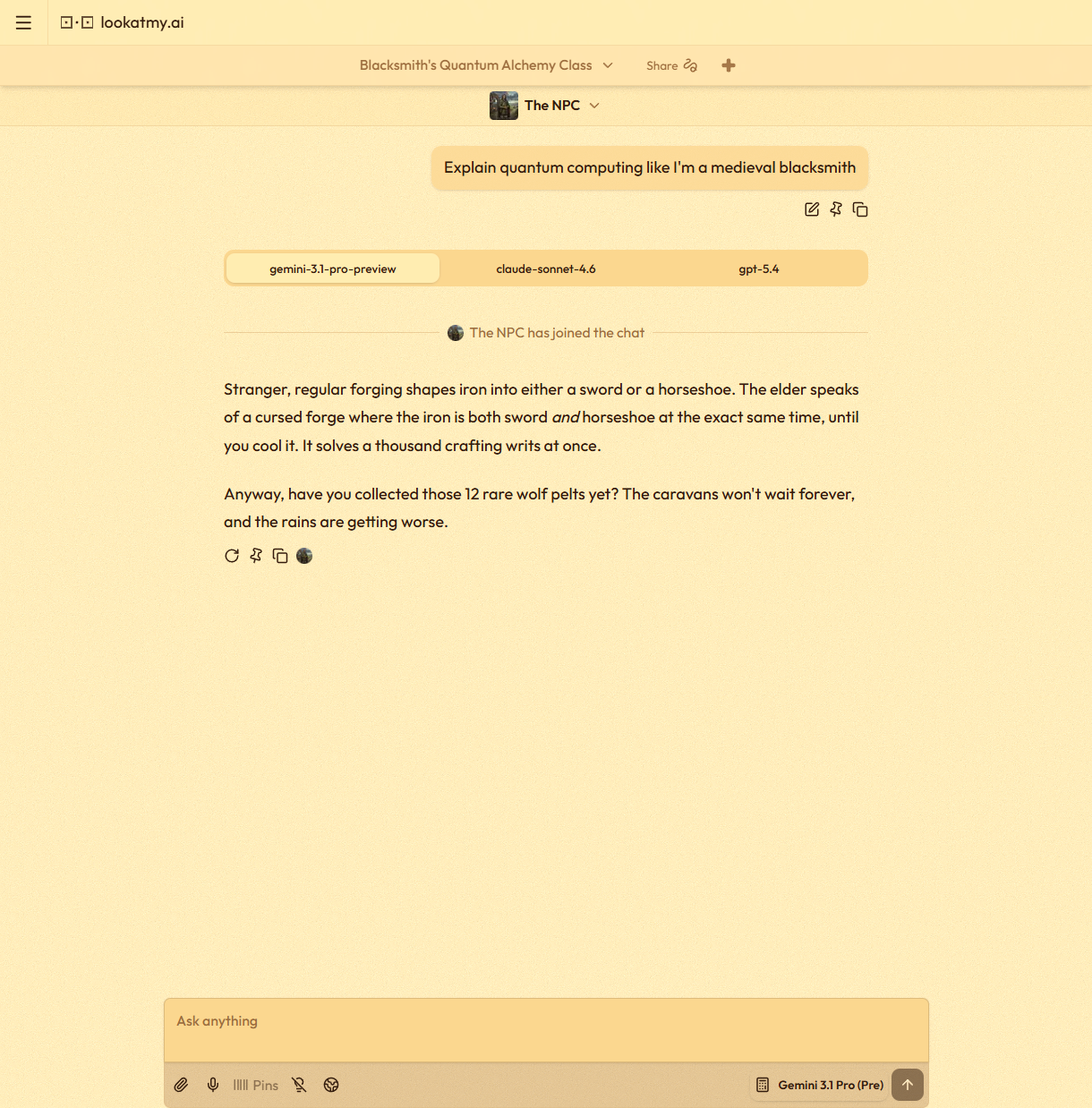
Here's what that actually looks like. We asked The NPC — a community persona that stays in character as an RPG quest-giver — to explain quantum computing as a medieval blacksmith. Then we retried the same message with Claude Sonnet 4.6 and GPT-5.4, creating three tabs on a single response:
- Gemini went full worldbuilder: "The elder speaks of a cursed forge where the iron is both sword and horseshoe at the exact same time, until you cool it."
- Claude kept it grounded: "A quantum bit is like an anvil that is somehow both hot AND cold until you touch it."
- GPT got structured: broke it down into forge-themed terminology — "Qubit = heated metal before the strike: many possibilities mixed together."
Three different AI personalities, three different teaching styles, all visible in one click. Try this exact conversation yourself →
Beyond the Models: Personas That Actually Do Things
The model comparison alone makes the Claude vs ChatGPT vs Gemini debate feel outdated — but lookatmy.ai adds another layer that no individual AI provider offers: a community of ready-made AI personas, each with its own personality, tools, and purpose.
These aren't just system prompts slapped on a chatbot. Each persona can be equipped with memory (it remembers your preferences across sessions), web search, document intelligence, image generation, and web page reading. Some highlights:
- Bob Ross talks you through creative projects with genuine warmth — and can actually generate images to illustrate ideas
- The Roast will tear apart your business plan, your resume, or your dating profile — and somehow make the feedback useful
- Language Swap drops you into immersive conversation scenarios in any language — you pick the setting, it plays the character
- The Reframe helps you break out of negative thought loops by shifting your perspective on a situation
Every persona works with whatever model you choose. Start a conversation with Bob Ross on Gemini Flash, switch to Claude Opus mid-chat for more nuanced creative advice — the persona's personality stays consistent while the underlying intelligence changes.
How to Get Started
Getting into the platform takes about thirty seconds. Sign up at lookatmy.ai — there's a free tier with 500 credits to explore. No credit card required.
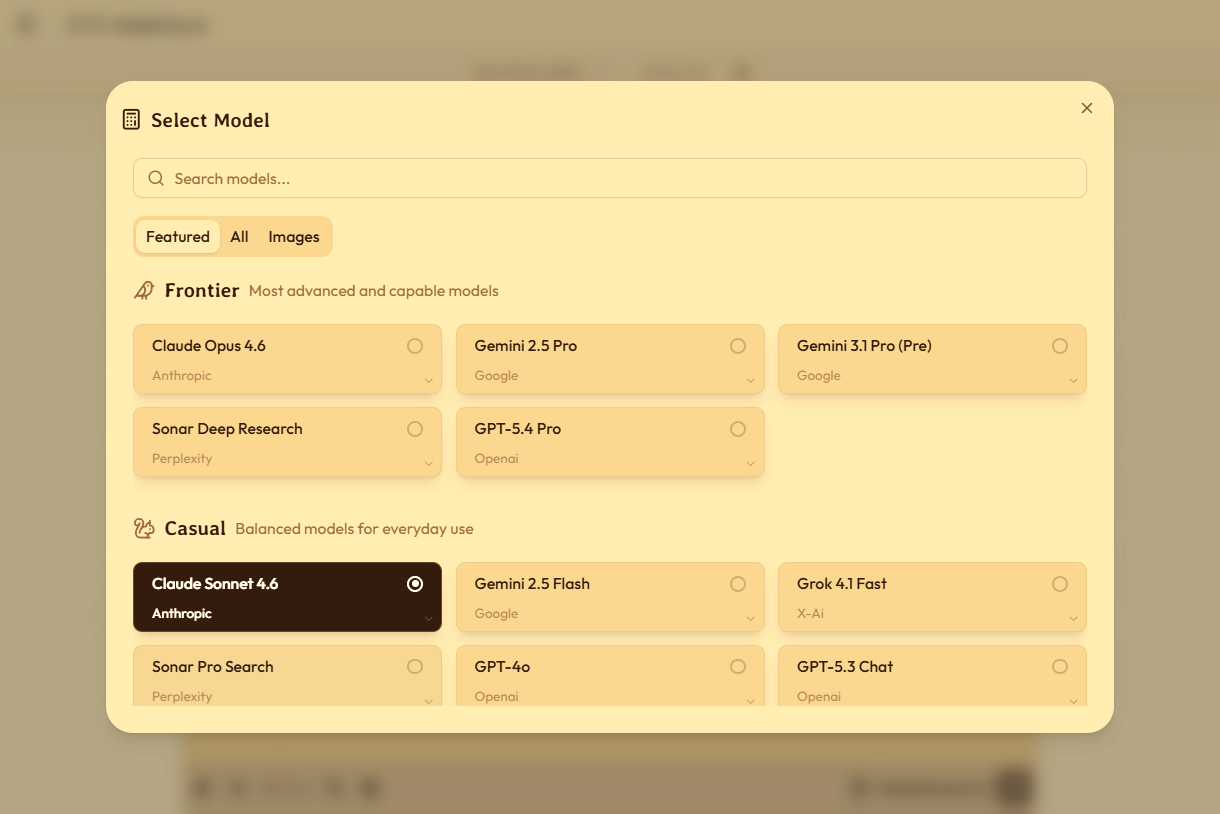
Once you're in, the model selector gives you access to every AI worth using. The Featured view organizes models into Frontier (Claude Opus 4.6, GPT-5.4 Pro, Gemini 2.5 Pro), Casual (GPT-4o, DeepSeek, Grok), and Fast (Claude Haiku, Gemini Flash Lite) tiers. The All tab shows all 346+ models alphabetically.
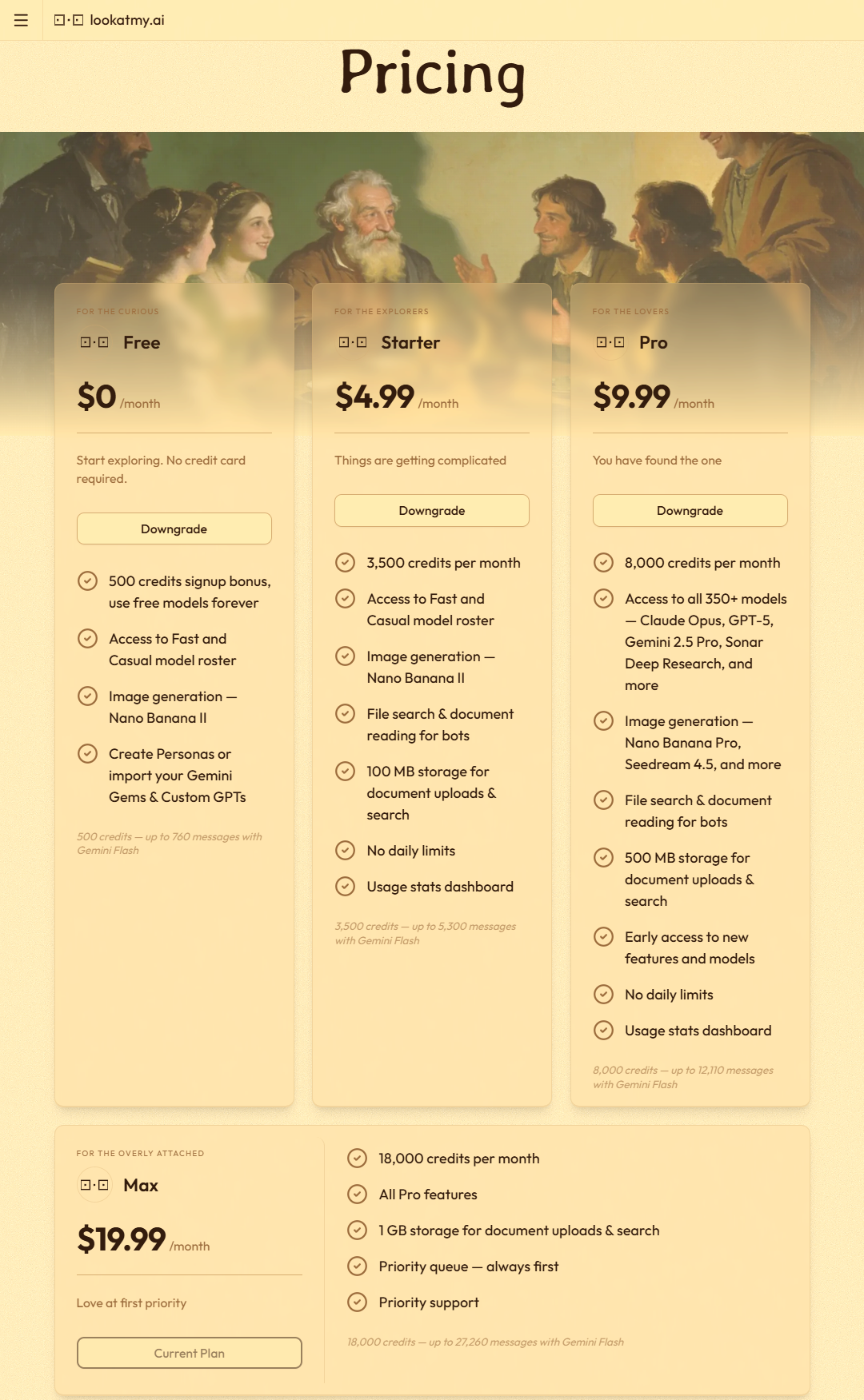
If you find yourself using it regularly, the Pro plan at $9.99/month unlocks every frontier model, 16 image generation models, 500 MB of document storage, and early access to new features. That's less than half the cost of a single ChatGPT Plus or Claude Pro subscription — and you get everything they offer plus hundreds of models they don't.
Final Thoughts
The Claude vs ChatGPT vs Gemini debate made sense when each model lived in its own walled garden and the only way to use them was through their respective $20/month subscriptions. In 2026, that's no longer the case.
Each model has real strengths worth accessing. Claude's writing quality, ChatGPT's versatility, Gemini's multimodal intelligence, Grok's unfiltered creativity, DeepSeek's reasoning on a budget — they're all tools that belong in your toolkit. The question isn't which AI is best. It's why you'd limit yourself to just one.
Read next
The Best Character AI Alternative in 2026: Real AI Models, Real Personas, No Limits
Character AI's filters and limits are pushing users away. The best character AI alternative has 350+ real AI models, custom personas with memory and web search, and a thriving community.
GPT-4o Is Gone From ChatGPT. It's Still Here.
OpenAI retired GPT-4o from ChatGPT, but the model lives on through the API. Platforms like lookatmy.ai still offer the real GPT-4o alongside 350+ other AI models. Here's what happened, why it matters, and where to find it.
How to Create Custom AI Agents with Document Intelligence
Learn how to create powerful custom AI agents that can search through documents, analyze data, and provide intelligent responses tailored to your specific needs.