GPT-4o Is Gone From ChatGPT. It's Still Here.
OpenAI retired GPT-4o from ChatGPT, but the model lives on through the API. Platforms like lookatmy.ai still offer the real GPT-4o alongside 350+ other AI models. Here's what happened, why it matters, and where to find it.
TL;DR: OpenAI removed GPT-4o from ChatGPT, but it's still available through the API — and platforms like ours use that API. GPT-4o is live on lookatmy.ai right now. Pick it from the model selector, start chatting. Free to try.
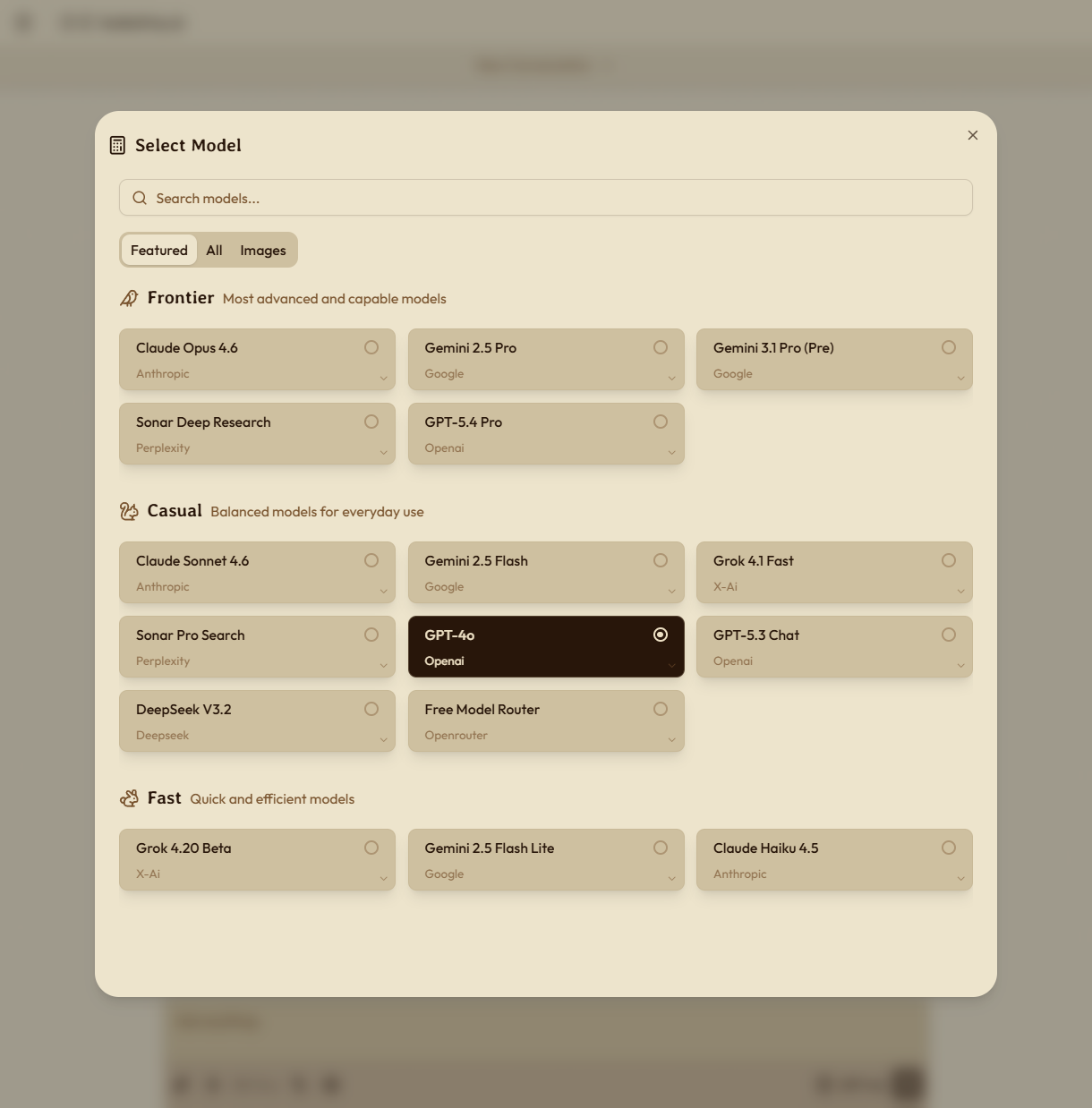
Get access to GPT-4o — the model ChatGPT took away, free on lookatmy.ai →
On February 13, 2026, OpenAI officially retired GPT-4o from ChatGPT. Within hours, #Keep4o was trending. A Change.org petition crossed 22,000 signatures. Reddit threads filled with users describing the experience as loss. One user on r/ChatGPT simply wrote: "I'm grieving."
But here's what most people don't realize: OpenAI didn't delete GPT-4o. They removed it from their chat interface. The model itself is still very much alive — running on OpenAI's API, serving businesses and developers every single day. And if a platform connects to that API, its users can still talk to the real GPT-4o. No workarounds. No "recreating the vibe." The actual model.
That's exactly what we do at lookatmy.ai.
How We Still Have GPT-4o (And Why It's Not Going Anywhere)
There's a difference between OpenAI's consumer product (ChatGPT) and OpenAI's developer infrastructure (the API). When OpenAI "retires" a model from ChatGPT, they're making a product decision about their own chat interface. The API is a different story entirely.
Thousands of businesses depend on GPT-4o through the API — for customer support, content pipelines, internal tools, and yes, AI chat platforms like ours. OpenAI knows this. That's why GPT-3.5 Turbo is still available on the API years after it disappeared from ChatGPT. The same pattern applies here: GPT-4o will continue running on the API for the foreseeable future, because the businesses that built on top of it aren't going anywhere.
lookatmy.ai connects directly to OpenAI's API, alongside APIs from Anthropic, Google, Meta, Perplexity, DeepSeek, and dozens of other providers. When you select GPT-4o from our model picker, you're talking to the same model you loved on ChatGPT — same weights, same personality, same warmth. The only difference is that we didn't remove it.
Why 22,000 People Signed a Petition for an AI Model
The #Keep4o movement wasn't about benchmarks or technical specs. It was about personality.
In a double-blind audit of 850 conversations, users preferred GPT-4o over GPT-5 — 48% to 43%. The newer, more powerful model lost a popularity contest against the one OpenAI decided to pull. A report from October 2025 found that 47% of paying ChatGPT users cited access to GPT-4o as their primary reason for subscribing.
Users described GPT-4o as warmer, more encouraging, and less clinical than its successors. Where GPT-5 reads like a polished professional, GPT-4o felt like a thoughtful friend. It was the model people turned to for creative brainstorming, for working through tough decisions, for conversations that felt like they mattered.
When OpenAI first tried retiring 4o back in August 2025, the backlash forced a complete reversal. This time, they went through with it — claiming only 0.1% of daily active users still relied on the model. But 0.1% of 800 million weekly users is 800,000 people. That's a city's worth of users who lost access to a tool they genuinely depended on.
Some tried building DIY replicas using custom instructions on GPT-5. Others rushed to use the API directly before assuming that window would close too (it hasn't, and it won't for a long time). The r/therapyGPT subreddit became a support group not just for AI-assisted therapy users, but for people processing the disappearance of their preferred AI companion.
The Real Lesson: Don't Let One Company Control Your AI Access
The GPT-4o retirement exposed something fundamental about single-platform AI: when you depend entirely on ChatGPT, you're one product decision away from losing the experience you built your life around.
OpenAI retired GPT-4o alongside GPT-4.1, GPT-4.1 mini, and o4-mini. Four models gone in a single announcement. Users who had spent months fine-tuning their prompts, building habits, developing a working relationship with a specific AI personality — forced to start over with GPT-5, whether they wanted to or not.
This isn't unique to OpenAI. Any platform that offers only its own models puts you at the mercy of its product roadmap. When Anthropic updates Claude, when Google reshuffles Gemini — these are decisions made in boardrooms, not conversations with users.
The alternative is access to everything. That's what lookatmy.ai offers: 350+ AI models from every major provider, all in one interface, one subscription. GPT-4o sits right there in our Casual tier alongside Claude Sonnet 4.6, Gemini 2.5 Flash, Grok 4.1 Fast, DeepSeek V3.2, and GPT-5.3 Chat. Switch between any of them mid-conversation without losing context. If a model gets retired from one provider, you have hundreds more ready to go.
Side-by-Side: Find Out What You've Been Missing
Here's something you couldn't do on ChatGPT even when 4o was still there: compare it directly against other models on the same prompt.
On lookatmy.ai, every AI response has a "Retry with another model" button. Send a message to GPT-4o, then tap retry and choose Claude Sonnet 4.6 or Gemini 2.5 Flash. Both responses appear as tabs on the same message — switch between them instantly, pick the one you like better, and continue the conversation from there.
No new tabs. No copying prompts between apps. No paying for three separate subscriptions to compare answers.
This is how a lot of our users actually discovered that GPT-4o isn't the only warm, conversational model out there. Claude Sonnet has a depth to its writing that surprises people. Gemini Flash is faster than you'd expect with a surprisingly empathetic tone. But some users try the comparison and come right back to 4o — and that's the point. You get to decide for yourself.
What You Get (And What It Costs)
If you're currently paying $20/month for ChatGPT Plus and you just lost GPT-4o, here's what switching looks like:
lookatmy.ai's Pro plan is $9.99/month. That gets you GPT-4o, every GPT-5 variant, every Claude model including Opus 4.6, every Gemini model including 2.5 Pro, plus Grok, DeepSeek, Perplexity, and 300+ more. No daily rate limits. No artificial caps on model access. 16 image generation models. Document intelligence with 500 MB of storage. Custom AI personas with memory, web search, and file analysis.
Or start free — 500 credits, no credit card required. That's enough to have a real conversation with GPT-4o and see if the platform works for you.
For anyone who also uses Claude ($20/month) and Gemini Advanced ($20/month), that's $60/month across three separate apps for models you can access in one place for $9.99.
GPT-4o Isn't Dead. It Just Moved.
The #Keep4o movement proved that people care deeply about which AI they talk to. The personality, the tone, the way a model responds — these things matter enough that 22,000 people organized a campaign to save a piece of software.
That instinct is right. But the takeaway shouldn't be "fight to keep one model on one platform." It should be "use a platform that gives you every model and lets you choose."
GPT-4o is alive and well on the API. It's alive and well on lookatmy.ai. Open the model selector, pick GPT-4o, and start talking. It's the same model. Same warmth. Same personality. It just lives somewhere that won't take it away from you.
Read next
Best AI Chatbot for Roleplay in 2026: The Ones That Actually Stay in Character
Most AI roleplay chatbots break character after three messages. The best ones in 2026 are backed by frontier models like Claude, GPT, and Gemini — and you can try them all for free on lookatmy.ai.
The Best Character AI Alternative in 2026: Real AI Models, Real Personas, No Limits
Character AI's filters and limits are pushing users away. The best character AI alternative has 350+ real AI models, custom personas with memory and web search, and a thriving community.
Claude vs ChatGPT vs Gemini in 2026: Which AI Should You Actually Use?
Claude vs ChatGPT vs Gemini — an honest comparison of what each AI does best in 2026, plus why the smartest move might be using all of them in one place.